
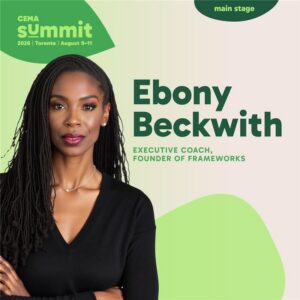
 The conversations that shape the C-Suite rarely start with strategy. More often, they begin with a question about how people show up as leaders.
Ebony Beckwith knows those conversations well. As a former Chief Business Officer and Chief of Staff at Salesforce, she helped drive decisions that defined how the company grew, communicated, and led through change. Her seat at the table came with a clear view of what influence really looks like and how it’s earned.
Now, through her leadership firm, Framework, Ebony is helping others do the same. She works with executives and teams to refine the skills that sustain leadership at every level: powerful communication, grounded confidence, and the ability to connect purpose to performance.
When she takes the main stage at CEMA Summit 2026 with Rise: Leading at Every Level, Ebony will explore what it really means to lead in today’s environment. Her perspective blends insight and intention, offering practical tools for professionals ready to strengthen their voice in rooms that matter.
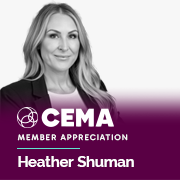 Meet Heather
Heather Shuman has been an active member of the CEMA community since 2022. As Director, Global Events + Experiences at Celonis, she leads strategic, high-impact programs that connect brand, experience, and business outcomes across global audiences.
Where Strategy Meets Community
Heather was drawn to CEMA by the caliber of its community — a group of peers who approach events not as a logistical function, but as a strategic business driver. That perspective aligned deeply with how she has always wanted to show up in her work.
Through her involvement, CEMA has sharpened her thinking around critical topics like ROI attribution, pipeline influence, and the role events play in the broader revenue ecosystem. It has also provided something equally important: a space to have high-level, strategic conversations that aren’t always possible internally. For Heather, CEMA serves as both a sounding board and a reminder that even in a demanding, high-stakes role, you’re not building in isolation.
More Than a Connection
One of Heather’s most memorable CEMA moments began as a simple networking interaction — and turned into something far more meaningful. When she met fellow member Dan Shuman, they initially bonded over sharing the same last name, laughing it off as coincidence.
Years later, while both serving on the Advisory Board, that curiosity resurfaced. After digging a little deeper — and with the help of Dan’s father — they discovered their grandfathers were brothers. What started as a chance introduction became a powerful reminder of just how deeply connection runs within the CEMA community. For Heather, it’s more than a network — it’s where she quite literally found family.
Designing the Future of Experience
Right now, Heather is deeply focused on the intersection of AI and experience personalization at scale. Working at Celonis, where intelligent processes are core to the business, she’s applying that same mindset to event strategy.
Her focus is not on making events more automated, but more intentional — using data and technology to enhance, rather than replace, the human experience. At the same time, she is doubling down on building programs that move beyond awareness and clearly drive pipeline, strengthening the attribution story so events are firmly positioned within the revenue conversation. For Heather, this balance between efficiency and experience is one of the most compelling design challenges in the industry today.
Designing Through Perspective
For Heather, travel is more than a requirement of the job — it’s a source of creative clarity. Experiencing spaces without the pressure of execution allows her to observe more intentionally: how people move, how environments shape behavior, and what makes a moment feel thoughtful versus incidental.
These experiences continually challenge her assumptions and expand her perspective, ultimately influencing how she designs events. Whether traveling professionally or personally, she sees it as a way to stay grounded in what truly matters when creating meaningful experiences.
Earning Influence, Then Redefining It
Heather’s guiding principle — “Earn the seat, then change the conversation” — reflects her approach to leadership in the events industry. Early in her career, she focused on operational excellence to prove credibility and secure a place at the table.
But the real impact came in shifting how leadership perceives events — from a cost center to a growth driver. She believes the most effective event leaders don’t rely on passion alone; they lead with data. By consistently showing the numbers, telling the story, and reinforcing the value, they reshape how events are positioned within the business.
Setting the Standard for Strategic Events
Looking ahead, Heather sees three major forces shaping the future of the industry: the normalization of AI in program design, increased pressure to prove ROI beyond attendance metrics, and a more selective executive audience.
The challenge, she notes, is avoiding the temptation to chase novelty — immersive experiences or new technologies — without anchoring them in meaningful outcomes. The opportunity for CEMA is clear: to lead the industry in defining what true strategic event leadership looks like. With its depth of experienced practitioners, Heather believes the community is uniquely positioned to set that standard.
Quick Takes with Heather
- Favorite event destination: Maine — home, always
- Go-to productivity hack: Time-blocking; if it’s not on the calendar, it doesn’t exist
- Event-day essential: A charged backup battery and lip gloss
- CEMA inspiration: Bridgette Birdie
- Biggest lesson this year: Reinvention isn’t a disruption to your path; it is the path
A Note of Gratitude
To the CEMA community: thank you for being a place where “I don’t have this figured out yet” is a conversation starter, not a confession. That’s rare, and it matters more than we realize.
Heather is a Director of Events & Experiences at Celonis, where she architects global event programs across multiple geographies and high-stakes stakeholder environments. With a career defined by the intersection of brand strategy, pipeline impact, and experience design, she brings a metrics-driven lens to everything from flagship summits to intimate executive engagements. CEMA has been a cornerstone community in her professional story.
Connect with Heather on LinkedIn.
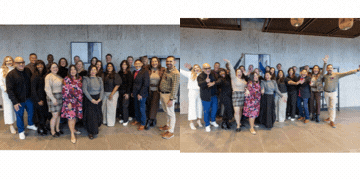 If you’re looking for a meaningful way to shape the future of CEMA, this is your opportunity to get involved. Our Advisory Board plays a key role in guiding programming, strengthening the member experience, and ensuring we continue to serve this community in a way that truly reflects your needs. Keep an eye out for more details—we’d love to see you raise your hand.
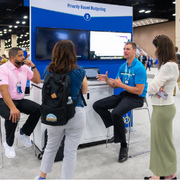 Some of the best events share a common feature that’s hard to pinpoint when you’re in the room: they feel calm. Not quiet or simple, just calm. Decisions are clear, the team knows what’s expected of them, issues are dealt with efficiently, and there is space for creativity since nobody is scrambling to fix things that should have been dealt with weeks ago.
That calm doesn’t happen by accident. It’s almost always the result of a strong partnership between event leadership and operations, one built on shared expectations, clear frameworks, and trust.
For years, corporate events have been evaluated mainly on creativity, experience design, and audience engagement. Those elements still matter, but expectations on event teams continue to rise, with tighter budgets, increased scrutiny, higher compliance requirements, and greater expectations around measurement and scalability. In this context, the differentiators are now those who can deliver consistently, at scale, without unnecessary risk or rework.
This is where event operations moves from a support function to a strategic capability.
Events have outgrown informal ways of working
Most event professionals are highly capable. We know how to run events, and many of us can do it in our sleep. That’s precisely why process and structure are often treated with suspicion, as administrative constraints dreamed up to make simple things harder.
But the reality is that events are not simple. They sit at the intersection of marketing, sales, finance, legal, data, and technology. Informal ways of working don’t fail because people lack experience; they fail because the system around them has become too complex to hold together through goodwill alone.
When teams trust the operating model, something important changes. Decisions happen earlier. Tradeoffs are surfaced instead of avoided. People move faster and take creative chances, because they understand the boundaries they’re working within.
What event ops actually does (and why it’s misunderstood)
Event operations teams are often perceived as process handlers. In reality, they act as the central nervous system of the event organization, connecting everything.
A mature ops function typically focuses on:
- Designing end-to-end ways of working across the event lifecycle, with an emphasis on making things slicker not harder.
- Governing budgets and spend, acting as a translator between event teams and finance, and reducing the stress that tends to build at month‑ and year‑end.
- Simplifying vendor, contracting, and compliance guidance, so teams stay within guardrails without feeling paralyzed by them.
- Building reporting and measurement into the system, improving visibility, credibility, and decision‑making over time.
- Owning the event technology ecosystem, with a focus on practicality, fitness, and adoption. Keeping the team trained on the latest advancements.
When these responsibilities are not clearly understood, Ops is either bypassed or overwhelmed; neither of which serves the business.
Operational intelligence is not the same thing as process
This is where the idea of operational intelligence becomes useful.
Operational intelligence isn’t about more rules, more tools, or more oversight. It’s about judgement and the ability to:
- Recognize patterns across events and portfolios
- Anticipate where things are likely to break
- Design guardrails that protect delivery without constraining it
- Decide where consistency matters and where flexibility is appropriate
This kind of intelligence is deeply human; built through experience, iteration, and reflection. Technology can support it, but it doesn’t replace it.
When operational intelligence is present, teams understand processes, why they exist and how to apply them intelligently.
What changes when ops and event leadership are aligned?
The benefits of strong partnerships and genuine alignment go way beyond efficiency.
Decisions land more cleanly
When intake criteria, approval paths, and escalation routes are defined, fewer things drift. People spend less time checking whether they can do something and more time deciding whether they should.
Creativity becomes more focused
Clear constraints are helpful. Vague ones aren’t. When teams understand the shape of the playing field early, creative effort goes into designing within it.
Stakeholder trust builds quietly
Consistency does a lot of work behind the scenes. When events are delivered predictably confidence grows, and scrutiny tends to soften.
Teams stay healthier
This is easy to underestimate. Clear frameworks and cadence reduce lastminute scrambles and the sense that everything is always urgent. Over time, that matters.
It’s not about being involved in everything, it’s about setting things up well
“Engaging ops early,” is often interpreted as needing operational involvement in every idea or decision. That’s not realistic, and it’s not necessary.
In practice, the value comes from doing the design work upfront:
- Agreed intake models
- Clear approval thresholds
- Standard templates for common event types
- Guardrails around budget, scope, and resourcing
When those are in place, many events can progress independently. Teams know what good looks like, exceptions are easier to spot, and support is focused where it adds the most value.
The goal isn’t to centralize every decision. It’s to decentralize delivery safely.
The quiet impact of an operating rhythm
One of the most effective things ops and event leadership can do together is establish an operating rhythm.
Regular forums to review priorities, budgets, and delivery status create a shared understanding of what matters right now. Over time, this replaces reactive escalation with informed discussion so that fewer things feel urgent, surprises are genuinely rare, and tradeoffs are made consciously; creating a steady tempo that supports better decisions.
From heroics to predictability
In many organizations, events succeed because individuals go above and beyond to “make it work.” While admirable, this approach does not scale.
Operational intelligence is about designing ways of working that do not depend on heroics. It creates predictability for stakeholders, leadership, and event teams themselves.
As the role of events continues to evolve, the most effective leaders will be those who invest as much in how events are delivered as in what they look like on the day.
A final reflection
The most effective event leaders don’t talk about ops as something separate from their work. They talk about it as part of how they lead.
They invest in frameworks, guardrails, and rhythm to give their teams room to do their best work.
When event operations works, everything else really does get easier.
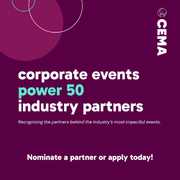 We all know that great events don’t happen alone—they happen with the right partners by your side. That’s why we’re launching the Corporate Events Power 50 Industry Partners. We’re recognizing those who go beyond execution to truly innovate, collaborate, and elevate your events. Think about the partner who shows up, solves problems before they happen, and helps you deliver stronger results every time.
Tell us who has made a real impact on your success, and why they deserve to be named one of the Corporate Events Power 50 Industry Partners.
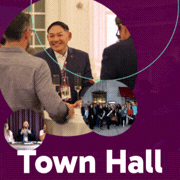 Join us for a live briefing on how CEMA is building toward Summit 2026 in Toronto. Get a preview of main stage plans, announced sessions, and early education and networking moments — plus updates on upcoming CEMA programs and ways to get involved throughout the year.
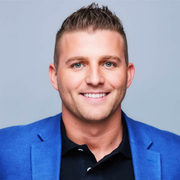 Rodney Hart, VP of Events | RainFocus
Coming out of our annual conference, I spent time digging through dashboards and metrics, each one offering a different view of success. But the more I looked at the data, the more I found myself stepping back and asking: what truly makes an experience a powerful way for attendees to connect with a brand?
For a long time, attendance has been one of the primary ways we’ve measured success. Bigger audiences, more registrations, higher reach. But scale alone doesn’t translate to stronger brand impact.
One of the biggest shifts I’m seeing is the growing importance of depth over breadth. Events are becoming less about generating awareness and more about reinforcing relationships with the audiences that matter most. The impact of an event is increasingly tied to relevance and connection, not just reach. More and more, executives care less about how many people are in the room and more about who is in the room.
At the same time, the way attendees experience a brand has fundamentally changed. Messaging and themes still matter, but brand is increasingly shaped through participation, including conversations, shared moments, and personalized ways to engage.
The lasting impact of a brand doesn’t come from the headlines. It comes from the interactions.
We’re seeing this in the rise of peer-to-peer engagement, interactive formats, and personalized experiences. These are not just programming decisions. They are brand decisions that shape how attendees perceive value and connect to the brand.
This is where events have a unique advantage. Throughout the year, we reinforce messaging across campaigns and content. But events create something different. They create space for people to feel inspired, learn, and connect in ways that are difficult to replicate elsewhere. That is what deepens brand connection.
At the same time, brand messaging now extends beyond the event. In many ways, it starts there and carries across channels long after. Attendees consume content across formats, including live, on-demand, summarized, and shared socially. Each becomes part of the overall brand experience. The message is no longer delivered once. It is experienced multiple times, often shaped by the attendee as much as the organizer.
As we look ahead, there is an opportunity to rethink how we define success. Not just in terms of attendance or satisfaction scores, but in terms of impact. Did the right people engage? Did they find value? Did they leave feeling more inspired, informed, and connected?
Because at their best, events are not just a channel for delivering messages. They are where brand becomes real.
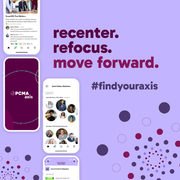

Something new is now live at the center of your CEMA membership. PCMA Axis is an interactive space designed to help you find your axis—stay connected with peers, discover relevant content, and join conversations that matter, no matter where you are in your career journey. Your members-only experience is officially here.
 PCMA Insights is your centralized source for industry research and strategic intelligence—designed to help you make more informed decisions and stay ahead of what’s next. As a CEMA member, you have full access to in-depth reports, including the latest Outlook 2026 findings.
 By Rich Uyttebroek, Director of Keynote Strategy and Delivery, Autodesk
From emerging tech panels to live music, from celebrity sightings to immersive brand activations (and yes, plenty of Texas BBQ)—ask any event or brand marketer what comes to mind when they hear “South by Southwest,” and you’ll likely get one of those answers.
But in 2026, there was a new question on everyone’s mind: How does SXSW work when the Austin Convention Center is a city-block-sized construction site?
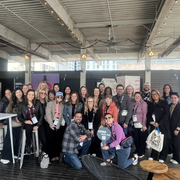
This year, 30 CEMA event marketers descended on Austin to find out: getting an inside look at how an event that draws more than 100,000 attendees over seven days continues to operate like a well-oiled machine, even while fundamentally reimagining its footprint.
In partnership with Visit Austin, the CEMA Study Tour group spent two days with SXSW leaders experiencing the newly distributed “South By.” We explored the event’s “clubhouse” model across its three core tracks—Innovation, Film & TV, and Music—while also stepping into standout brand activations like the Superhuman House at Antone’s, which guided attendees through the “Epochs of Human Communication.” Along the way, we joined thought-provoking sessions on the future of brand marketing and audience engagement.
Day 2 began at the Visit Austin offices overlooking Lady Bird Lake, where participants heard directly from SXSW leaders about the realities of producing this year’s event, from logistical challenges to lessons learned, and their vision for the future of a festival that continues to evolve at the intersection of culture and technology.
CEMA Study Tours are a powerful way to gain fresh perspective, bring new ideas back to our teams, and build meaningful connections with fellow event marketers. And for Austinites like me, the SXSW Study Tour offered a rare behind-the-scenes look at an event I’ve experienced from the outside for years.
A huge thank you to SXSW, Visit Austin, and the CEMA team for an unforgettable experience.

Missed the webinar? You can still catch the insights on demand.
This session explores what truly makes event experiences resonate—from how messaging and format shape real-time engagement to what ultimately drives action after the event. Backed by insights from over 1,000 attendees in Invision’s 2026 Business of Experiential Report, the conversation unpacks what builds trust, keeps audiences immersed, and turns moments into meaningful outcomes. Watch the recording to walk away with practical takeaways you can apply to your own events.
 CEMA Summit is where the industry shows up—and sponsorship opportunities are going quickly. Join us in Toronto, Canada, August 9–11, as we bring together 800+ CEMA/PCMA members for three days of high-impact content, connection, and community.
From hands-on networking experiences to premium branding and advertising placements, there are powerful ways to put your company front and center with event marketing leaders.
Explore all available opportunities in the prospectus and secure your spot before we sell out »
 ITA Group, a global events agency, has designed and executed live, virtual and hybrid events for over 60+ years, including 4,000+ events over the last 10 years. Our in-house team of 400+ events experts transform business objectives into action, specializing in strategy, creative, logistics and management, production, sponsorship, gifting, and analytics. From incentive travel and sales kickoffs to user conferences and tradeshows, we create memorable experiences, leveraging data and creativity to maximize engagement, ROI and brand storytelling.
What will you learn next with your CEMA member benefits?
PCMA Institute’s annual subscriptions are included in your CEMA membership and grant you unlimited access to a digital library. You can also take advantage of a 20% discount on certificate courses.
Explore all courses »